


What if the most profound design choice for your nursery isn't the furniture, but the integrity of the threads that touch your baby's skin? You've likely felt that nagging hesitation whilst browsing high-end boutiques, wondering if a "luxury" tag justifies the price or simply masks another mass-produced textile. It's a valid concern. You deserve a sanctuary that feels as intentional as it is beautiful, where every piece tells a story of meticulous curation. Choosing hand-finished baby bedding isn't merely about aesthetics; it's an investment in safety, comfort, and a legacy that begins from the very first night.
This guide will empower you to distinguish true artisan craftsmanship from industrial imitations, ensuring your nursery reflects your unique visionary style. We'll explore how bespoke textiles provide the ultimate assurance for infant skin sensitivity and why they are the only solution for non-standard cot dimensions. From understanding certified organic standards to the art of the heirloom quilt, you'll discover how to create a space that is both a safe haven and a lasting family treasure.
Key Takeaways
- Learn to identify the subtle hallmarks of artisan excellence, from hand-sewn hems to the intricate depth of hand-guided embroidery.
- Understand the structural advantages of hand-finished baby bedding, where meticulous seam work ensures both safety and longevity for your bespoke nursery.
- Gain a practical checklist for distinguishing genuine luxury craftsmanship from mass-produced imitations that often compromise on fabric integrity and sensory drape.
- Discover how to integrate heirloom-quality textiles that accommodate non-standard cot sizes whilst selecting a colour palette that evolves with your child.
Beyond the High Street: Why Hand-Finished Baby Bedding Defines the Luxury Nursery
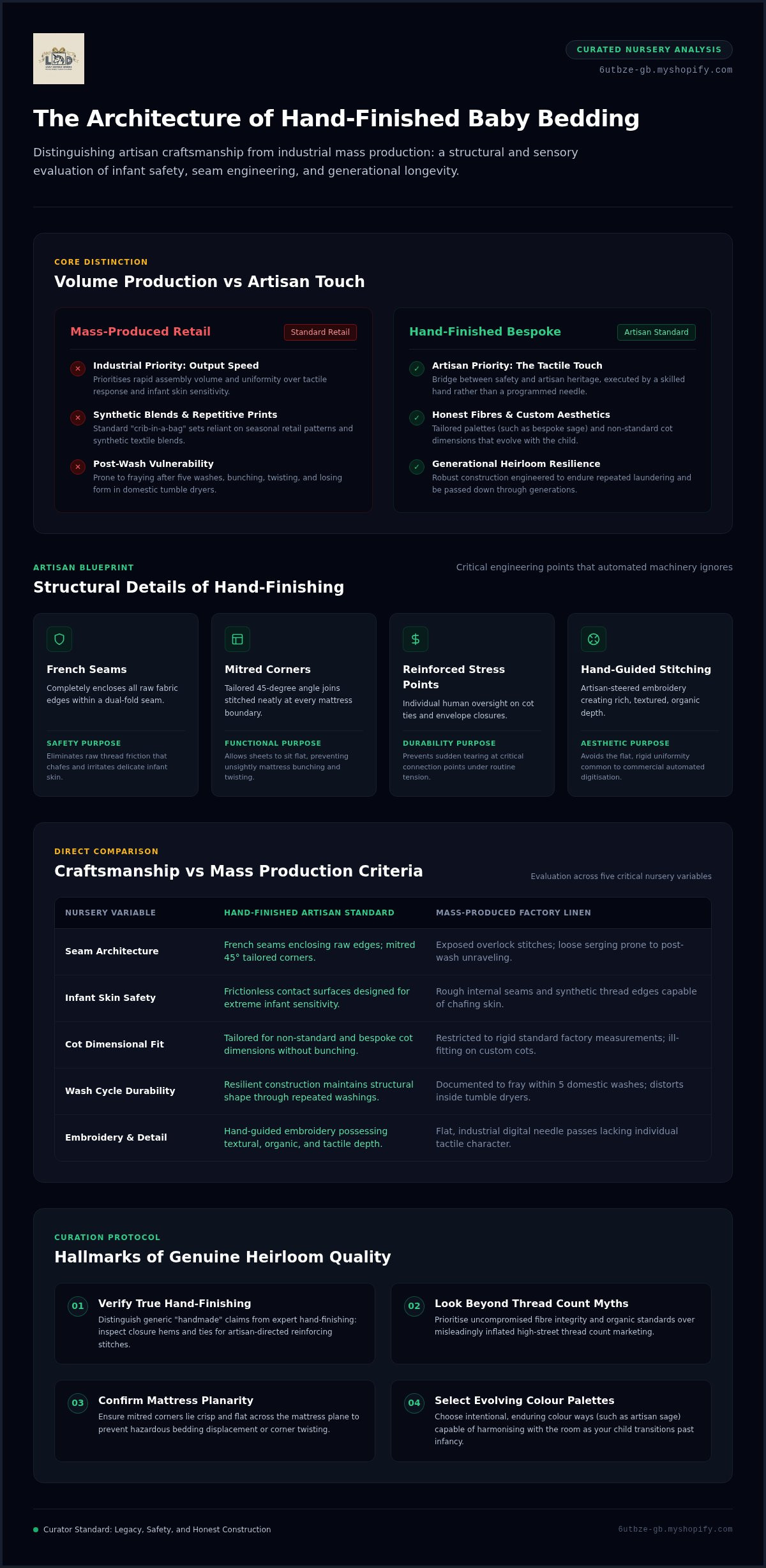
High-street nursery brands often sell a dream of convenience, yet the reality is frequently a sea of synthetic blends and repetitive patterns. True luxury resides in the details that a machine simply cannot see. Hand-finished baby bedding represents the bridge between industrial safety and artisan heritage. It refers to textiles where the final, most critical elements, such as the delicate closing of a seam or the precision of a mitred corner, are executed by a skilled hand rather than a programmed needle. This isn't just about finishing a product; it's about perfecting a vision.
For the visionary parent, this choice marks a significant emotional shift. You aren't merely buying a functional product. You are commissioning a piece of your family's history. This transition from consumer to curator is essential in creating a sensory nursery. In this space, the tactile experience is just as vital as the visual. How does the fabric feel against a newborn's skin? Does the weight of the blanket offer a sense of grounded security? These are the questions that mass-produced "crib-in-a-bag" sets fail to answer. They prioritise volume; we prioritise the touch.
The Emotional Value of Heirloom Quality
In an era of throwaway culture and fast-fashion textiles, there is a quiet power in choosing longevity. Bespoke pieces don't just occupy a room. They hold memories. When you invest in handmade heirloom baby blankets, you are selecting a gift for the future. These aren't items that fray after five washes or lose their shape in a tumble dryer. They are robust, honest creations designed to be passed down through generations. They carry the weight of tradition. They represent a commitment to excellence that outlives the nursery years, becoming a constant thread in your child's growing story.
Rejecting the Ordinary: The One-of-a-Kind Promise
Exclusivity is the hallmark of high-end design. Why settle for a standard retail palette when you can define your own aesthetic? Hand-finishing grants you the freedom to move beyond seasonal trends. It allows for a level of customisation that automated factories cannot replicate. Whether it is a specific shade of sage to match your bespoke wallpaper or the inclusion of traditional hand embroidery, the result is always unique. Machines prioritise speed and uniformity. Artisans prioritise character and soul. This meticulous attention to detail ensures that your hand-finished baby bedding isn't just another layer; it's the anchor of a one-of-a-kind nursery.
The Artisan’s Touch: Understanding Hand-Finishing Techniques and Premium Materials
Distinguishing between handmade and hand-finished is essential for the discerning eye. Whilst many products claim to be handmade, the technical reality of hand-finished baby bedding lies in the expert execution of final, structural details. It is a process that demands patience. It requires an artisan to supervise every stitch. This human oversight ensures that stress points, such as cot ties and envelope closures, are reinforced with a level of precision that automated high-speed machinery simply ignores. It transforms a simple textile into a durable masterpiece characterized by its honest construction.
Technical Excellence: Mitred Corners and French Seams
Why do these specific techniques matter in a nursery setting? Mitred corners provide a crisp, tailored finish that allows sheets to sit perfectly flat against the mattress. This prevents the unsightly bunching and twisting that often plagues mass-produced linens after a few cycles in the wash. For your baby's comfort, French seams are the gold standard. By completely enclosing raw fabric edges, these seams ensure there is nothing to chafe or irritate delicate infant skin. It is a meticulous method that prioritises safety through superior construction. This level of care extends to the decorative elements too. Unlike the flat, repetitive nature of digital stitching, hand-guided embroidery offers a textured, organic depth. You can explore the history of these techniques in this guide to artisan embroidery styles from the Victoria and Albert Museum.
Material Curation: Beyond Basic Thread Count
Don't be misled by the marketing myth of high thread counts. In the world of premium nursery design, the integrity of the fibre is paramount. We focus on "honest" materials like long-staple cotton and Belgian flax linen. These fibres are naturally breathable. They assist with infant temperature regulation whilst offering a sensory softness that improves with every wash. Selecting these materials means rejecting the harsh industrial chemicals often found in treated, mass-market cottons. It is about choosing purity. When you invest in artisan made products, you are choosing fabrics that meet the highest safety standards. The result is a sleep environment that feels both grounded and ethereal, designed for longevity rather than obsolescence. This commitment to material integrity is what truly defines the value of your hand-finished baby bedding.
A Comparative Look: Hand-Finished vs. Mass-Produced Nursery Textiles
Does the term "luxury" actually mean anything in a world of industrial reproduction? For many parents, the disappointment begins after the first wash. Mass-produced nursery textiles rely on high-speed machine overlocking. It's fast. It's cheap. It's also prone to fraying at the slightest tension. In contrast, hand-finished baby bedding utilises deliberate, reinforced stitching that respects the fabric's natural grain. This artisan approach prevents the structural failure common in factory-line products. It ensures that every seam remains a point of strength rather than a looming repair.
The difference in sensory experience is equally stark. Mass-market cottons often undergo chemical treatments to mimic a soft hand-feel that disappears after one laundry cycle. Artisan fabrics, however, rely on the inherent quality of the fibre. They possess a superior drape and a weight that feels substantial yet breathable. By choosing small-batch production, you also reject the staggering environmental waste associated with industrial textile manufacturing. It's a choice that favours the health of the planet whilst prioritising the comfort of your child. It is honest craftsmanship that refuses to cut corners.
The Longevity Test: Washing and Wear
Have you ever noticed how cheap cot sheets warp and twist, making them impossible to fit correctly? This happens because high-volume machines pull fabric taut during sewing, creating latent tension. Hand-finishing allows the material to sit naturally. It stays smooth. It resists the "pilling" that turns soft sheets into abrasive surfaces over time. When viewed through a legacy lens, the investment makes perfect sense. These pieces don't just survive infancy; they thrive. They maintain their integrity, justifying their place as a family heirloom through a significantly lower "cost-per-use" than disposable alternatives.
Bespoke Sizing: The End of "Making Do"
The struggle to find bedding for a vintage heirloom cot or a contemporary non-standard mattress is a common source of anxiety. Standard retail sizes are rigid. They often force parents into dangerous "making do" scenarios with loose fabric or ill-fitting corners. Bespoke solutions eliminate this risk entirely. Every piece is tailored to your specific dimensions, ensuring a snug, safe fit that adheres to crib safety and safe sleep standards. Choosing luxury nursery bedding UK means you no longer have to compromise on safety for the sake of style. It's a collaborative path to a perfectly fitted, one-of-a-kind sanctuary.
Selecting for Longevity: A Visionary’s Guide to Curation and Care
True curation is an exercise in restraint. It is the art of choosing "less but better" to ensure your nursery remains a serene sanctuary rather than a cluttered storeroom. When you invest in hand-finished baby bedding, you aren't just buying for the newborn phase. You are selecting pieces with the resilience to transition into the toddler years and beyond. This longevity depends on your ability to identify genuine quality and commit to a mindful care routine that respects the artisan's work.
The Curation Checklist: What to Look For
How do you distinguish a masterpiece from a high-street imitation? Start with the stitches. True hand-finishing reveals a consistent yet organic tension that machines cannot mimic. Look for hidden seams and the absence of loose threads at stress points. The "weight" test is equally telling. High-quality natural fibres possess a substantial, grounding feel that suggests durability. Finally, scrutinise the attachments. Ensure all ties are reinforced with hand-stitched bar tacks, meeting rigorous safety standards whilst maintaining an elegant, tailored silhouette. These details are the silent markers of excellence.
Your colour palette should also reflect this long-term vision. Avoid fleeting trends or overly juvenile patterns. Instead, opt for sophisticated neutrals, muted earth tones, or classic heritage shades. These colours evolve gracefully. They allow you to update the room's aesthetic with small accents whilst the bedding remains a timeless anchor. It is a collaborative approach to design that prioritises enduring style over temporary fashion.
Preserving the Artistry: Care and Storage
Preserving delicate embroidery and hand-sewn elements requires a gentle touch. Always utilise enzyme-free, mild detergents and low-temperature cycles to protect the natural integrity of the fibres. To prevent warping, avoid the aggressive heat of a tumble dryer. Instead, air-dry your linens flat, keeping them away from harsh, direct sunlight which can brittle the threads and fade the pigments. Between uses, protect your investment by organising heirloom pieces in nursery baskets & storage. This keeps the fabric breathable and shielded from dust or accidental snags.
Ready to begin your journey toward a bespoke nursery? Explore our collection of artisan made products and discover the difference that meticulous hand-finishing makes to your home.
Creating a Legacy: Integrating Bespoke Bedding into Your Nursery Design
Your nursery’s aesthetic narrative begins at the cot. It is the architectural heart of the room. It is where your child will spend their most formative hours. Because of this, hand-finished baby bedding should never be an afterthought or a last-minute retail acquisition. Instead, it serves as the vital anchor that grounds your entire design scheme. It bridges the gap between a purely functional sleep-space and a curated, artistic sanctuary. When you select bespoke textiles, you aren't just decorating. You are defining the atmosphere of your child's first world.
Integrating these pieces requires a shift in perspective. Think of your nursery as a collaborative journey. We move beyond the limitations of high-street collections to create a space where bedding, wall treatments, and furniture speak the same language. This might involve echoing a subtle motif from a hand-painted mural in the delicate embroidery of a duvet cover. It could mean matching the exact tone of a heritage wood finish to the piping on a cot skirt. This cohesion is what separates a standard room from a visionary legacy.
The Designer’s Perspective: Layering Textures
Depth in design comes from the thoughtful layering of textures. A rich, sensory environment is essential for infant development and parental calm. We achieve this by mixing the crisp, tailored lines of hand-finished linens with the soft, tactile warmth of heirloom blankets. This contrast creates a visual and physical landscape that feels lived-in yet exceptionally polished. By utilising bespoke nursery interior design, you ensure that every element, from the window dressings to the smallest cushion, contributes to a singular, sophisticated narrative. It is about creating a home for your child that feels intentional, safe, and undeniably beautiful.
Your Design Journey Starts Here
Are you ready to move from inspiration to execution? Transitioning from a vague vision to a finished, polished result can feel overwhelming. You shouldn't have to navigate these decisions alone. A professional design partner provides the lead, offering the practical assurance of quality whilst celebrating your individual style. This collaborative path offers more than just a beautiful room. It provides the peace of mind that comes from an expert-led, curated solution.
The nursery is the very first environment your child will experience. It is the backdrop to their earliest memories. Make it extraordinary. We invite you to explore our comprehensive nursery design services and discover how we can help you build a legacy that begins with the finest threads. Let’s create something truly one-of-a-kind together.
Begin Your Nursery Legacy
Choosing the right textiles for your nursery is a profound act of care. You've discovered that hand-finished baby bedding represents more than just a design choice; it's a commitment to safety, technical excellence, and artisan heritage. By moving beyond the high street, you ensure that every seam and stitch serves as a durable foundation for your child's earliest memories. These pieces don't just fill a room. They build a legacy that transcends the cradle.
Whether you're solving the puzzle of a non-standard cot size or seeking a one-of-a-kind interior that reflects your visionary style, the path forward is a collaborative one. Identify your need. Present your vision. Execute with precision. Expert design consultation and artisan-made heirloom pieces are within reach to transform your nursery from a functional space into an artistic sanctuary. It's time to bring your vision to life with the honesty of true craftsmanship.
Discover the Art of the Bespoke Nursery at Lively Distinct Designs and begin your journey toward an extraordinary environment where your baby can thrive. Your legacy starts here.
Frequently Asked Questions
What is the difference between handmade and hand-finished bedding?
Hand-finished baby bedding differs from handmade items by focusing on the final, critical details that define technical quality. Whilst a machine may perform the initial construction, an artisan executes the hems, mitred corners, and intricate embroidery by hand. This ensures structural integrity and a level of precision that automated systems cannot replicate. It transforms a functional textile into a piece of artistry. You are investing in the human touch that guarantees perfection at every stress point.
Is hand-finished baby bedding safe for newborns?
Safety is the cornerstone of bespoke design. Hand-finished bedding is safe for newborns when it adheres to strict safe sleep standards, such as ensuring a tight, snug fit on the mattress. By utilising natural, honest materials like long-staple organic cotton, you eliminate the risk of harsh industrial chemicals. These fabrics are hypoallergenic and breathable. They support temperature regulation whilst protecting your infant's sensitive skin from the irritations often caused by mass-produced synthetic blends.
Can I get bespoke bedding for a non-standard cot size?
Bespoke bedding is the ideal solution for non-standard or vintage cot dimensions. Standard retail sheets often result in loose, hazardous fabric or ill-fitting corners that compromise safety. Commissioning custom-made pieces ensures a perfect, tailored fit for any mattress size or shape. This precision provides peace of mind whilst allowing you to maintain the aesthetic integrity of a unique nursery. It effectively ends the struggle of making do with standard high-street alternatives that simply do not fit.
How do I wash hand-finished luxury textiles without damaging them?
Preserving the artistry of luxury textiles requires a mindful laundering routine. Always use enzyme-free, mild detergents and select low-temperature cycles to protect the natural fibres. Avoid the aggressive heat of a tumble dryer, as this can brittle the threads and warp hand-sewn elements. Instead, air-dry your linens flat, ensuring they are kept away from harsh, direct sunlight to prevent fading. This gentle approach ensures your heirloom pieces remain soft and beautiful for generations to come.
Why is hand-finished bedding more expensive than organic mass-market options?
The price reflects a shift from industrial volume to artisan excellence. Unlike mass-market organic options, hand-finished bedding involves technical tailoring such as French seams and mitred corners which prevent warping and fraying. You are paying for the time of a skilled artisan and the structural integrity that allows a piece to become a family legacy. It is a less but better investment. These textiles offer a lower cost-per-use because they are designed to outlive the nursery phase.
What materials are best for heirloom-quality baby bedding?
Long-staple cotton and Belgian flax linen are the premier choices for heirloom-quality linens. These natural fibres are celebrated for their breathability and exceptional durability. Unlike mass-market cottons that pill and thin after frequent washing, these artisan-selected materials actually soften and improve with age. They provide a grounding, sensory experience that is both luxurious and honest. Selecting these materials ensures your bedding remains a beautiful, functional anchor in the nursery for years to come.
How do I choose a colour palette that won’t date quickly?
To ensure your nursery aesthetic remains timeless, focus on sophisticated neutrals and muted heritage tones. Shades such as soft stone, sage, or warm ivory provide a serene backdrop that evolves gracefully as your child grows. These colours act as a permanent anchor, allowing you to update the room's character with smaller, seasonal accents. By avoiding fleeting, juvenile trends, you create a sanctuary that feels intentional and elegant. It is a design choice that prioritises longevity over temporary fashion.
Can hand-finished bedding be customised with my child’s initials?
Personalisation is a hallmark of the bespoke journey. Hand-finished bedding can be customised with your child’s initials or a family crest through hand-guided embroidery. This process adds a layer of exclusivity and personal narrative to the nursery, ensuring every piece is truly one-of-a-kind. Unlike digital, flat monograms, artisan needlework offers a textured depth that reflects the heritage of the piece. It is the final, intimate detail that transforms a luxury textile into a cherished family heirloom.


